
 Article
Maximizing Whole-Building Efficiency Through Dual-Fuel and Natural Gas Innovation
Commercial + Industrial|Natural Gas
As a dual-fuel alliance, NEEA is uniquely positioned to explore integrated fuel opportunities that deliver affordable, reliable energy to Northwest customers. By leveraging the strengths of electricity and natural gas, NEEA works to ensure that customers benefit from proven technologies that make the best use of both systems.
One way that commitment is taking shape in 2026 is through field demonstration of a dual-fuel approach for water heating. Launched in December 2025 under NEEA’s Advanced Commercial Water Heating program, this demonstration will analyze real-world performance of a dual-fuel system. Dual-fuel systems have the potential to save up to 22% when fully optimized. Achieving such savings is based on many factors including piping configuration, building type, the portion of each fuel contributing to water heating, and the local pricing of each fuel type. NEEA’s research through the Advanced Commercial Water Heating program will help provide guidelines for designers and installers to best optimize each system.
Optimizing Dual-Fuel Water Heating
Traditional water heating systems are often optimized around a single fuel source. This new approach looks at the entire system, sizing and designing it so electric and gas heat sources work together, each operating where it performs best.
In the dual-fuel configuration, an electric heat pump, two tank gas water heaters, and a storage tank operate in tandem. While the system can run each fuel independently, it achieves the best results when configured to use both strategically.
The electric heat pump provides the greatest temperature lift. It efficiently heats incoming cold city water to a much higher baseline temperature. Because heat pumps are most efficient when running in longer, steady cycles, this design allows the electric system to operate more effectively, avoiding inefficient short cycling that can degrade performance.
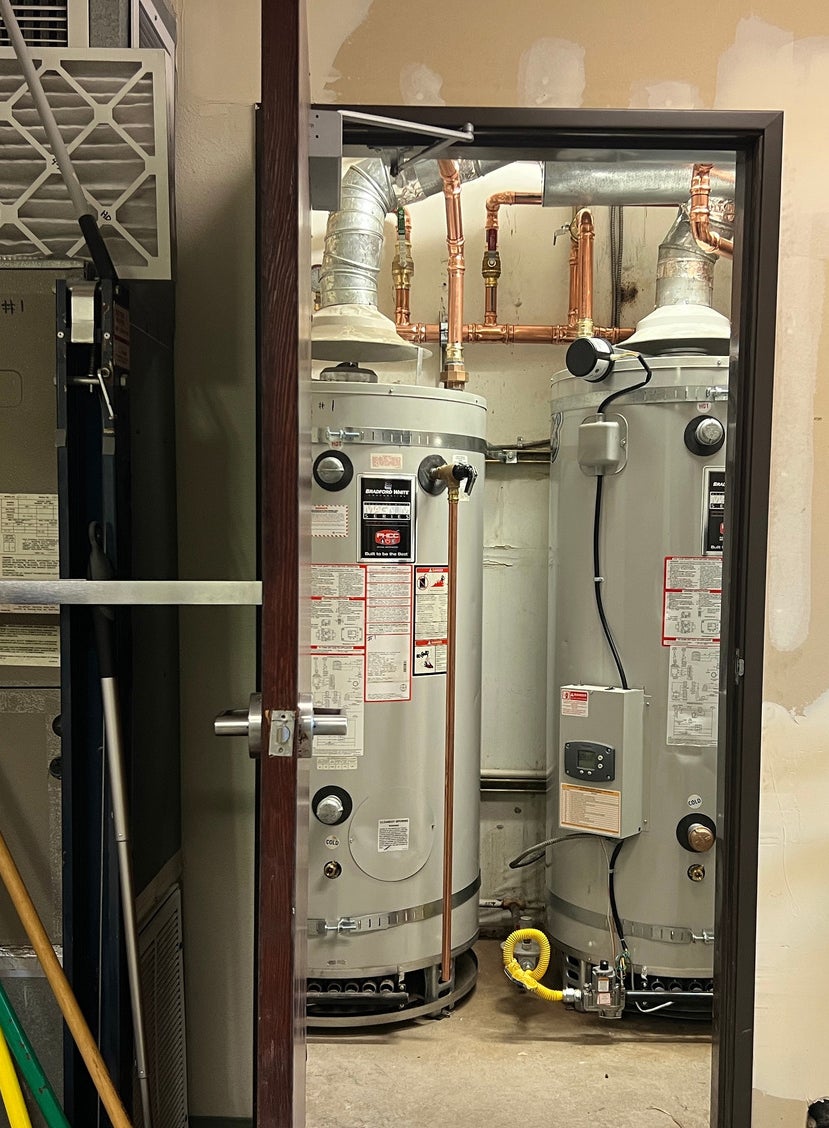
The gas water heater then “tops off” the preheated water, maintaining it at the desired delivery temperature. Gas equipment, while having efficiency limitations compared to heat pumps, can cycle more easily and respond quickly to fluctuating demand. By reserving gas for this finishing role, the system minimizes electric heat pump cycling and increases the effective efficiency of the natural gas component.
The result is a coordinated, whole-system solution that capitalizes on the strengths of each fuel. One of the key objectives of the field trials is to validate the optimal switchover point between electric and gas operation, identifying the most efficient roles of each plant and demonstrating real-world efficiencies.
Field Demonstration Underway in Portland
NEEA is currently conducting a field demonstration in multifamily housing in Portland, served by Pacific Power and NW Natural.
At River Haven, a recovery community operated by Central City Concern, installation of the dual-fuel system is complete. The system is delivering consistent hot water, an essential component of resident safety and comfort. Metering equipment collects comprehensive performance data, and testing will soon begin on six different load variations between the electric heat pump and gas equipment. These variations will help identify the configuration that produces the greatest energy and cost savings while maintaining reliable service.
The River Haven demonstration will meter load variations over the course of a full year, with a final report expected in Q1 2027.
Seeking Partners and Looking Ahead
As testing continues, NEEA is seeking additional field trial sites – particularly hotels and multifamily buildings. Expanding the dataset across building types and usage patterns will further refine guidance on optimal system configuration and switchover strategies.
Through these efforts, the alliance is advancing a new chapter in dual-fuel and natural gas efficiency collaboration that is grounded in data, focused on total end-use efficiency, and designed to deliver meaningful savings and reliable performance for Northwest customers.
Interested in participating in a field trial? Contact Melissa Mejía, NEEA program manager.