
 Article
Northwest Focus, Worldwide Savings: Television Market Transformation

Residential
Market Transformation often takes years of sustained effort before individual pieces begin to come together. In 2026, major milestones in television efficiency did just that.
Expanded industry voluntary agreements, advances in international test standards, new collaborations with the California Energy Commission (CEC), and years of NEEA leading and supporting technical research, testing, and stakeholder engagement are all culminating to help shape how energy usage in TVs and other electronic products is measured and reduced.
Together, these developments demonstrate how continual Market Transformation work can create impact well beyond the Northwest while ultimately bringing more efficient products and energy savings back to Northwest consumers.
Building the Foundation for More Efficient Televisions
Nearly two decades of sustained investment in technical research, product testing, market intelligence, stakeholder engagement and standards development are now reaching a pivotal moment. NEEA’s work has helped shape the underlying technical infrastructure that manufacturers, policymakers and market actors use to define and measure efficiency. In turn, these efforts are translating into broader manufacturer commitments, international standards and lasting market change – demonstrating how regional leadership can drive efficiency improvements on a global scale.
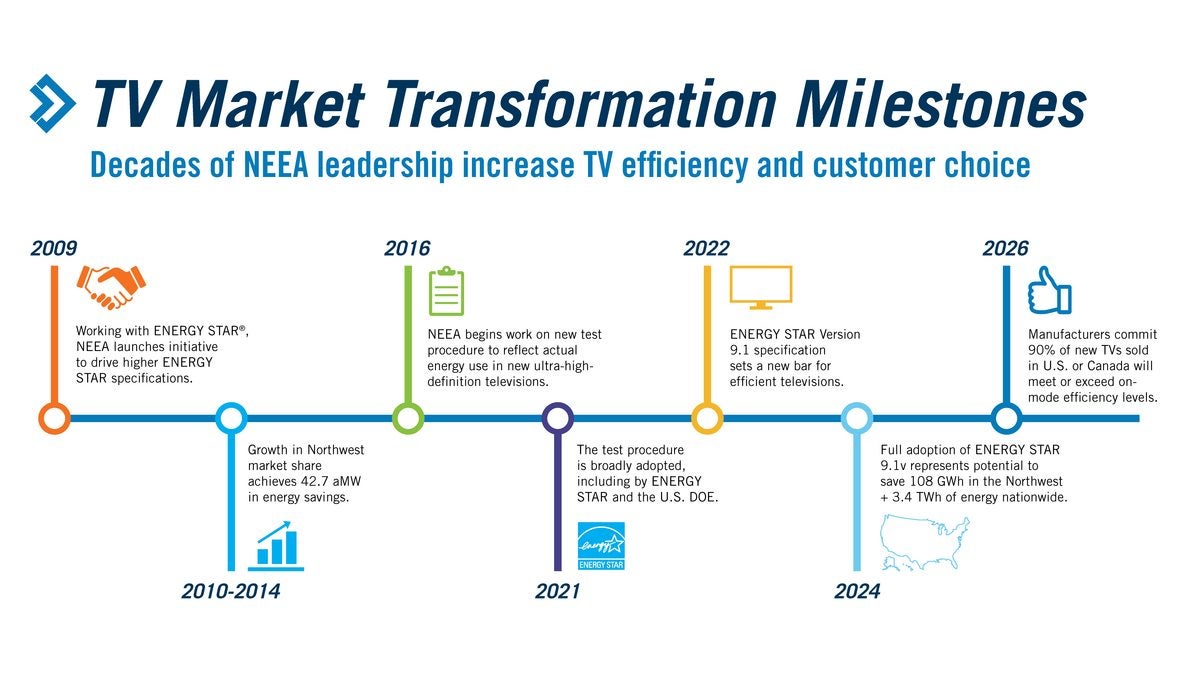
In 2009, as the transition to digital broadcasting accelerated the adoption of flat-panel televisions, NEEA recognized that growing screen sizes and new technologies could significantly increase regional energy use. Working with ENERGY STAR®, NEEA launched an initiative to raise efficiency specifications for televisions, influence state and federal efficiency standards, and increase the availability of efficient models on retail shelves.
These efforts rapidly shifted the market. Between 2010 and 2014, growth in Northwest market share of the most energy-efficient televisions delivered 42.7 average megawatts (aMW) of energy savings, enough to power more than 31,000 homes annually.
In 2016, NEEA took on a fundamental challenge: accurately measuring how much energy modern TVs use. The alliance began work on a new test procedure to reflect actual energy use in new ultra-high-definition TVs.
NEEA partnered with the Consumer Technology Association® (CTA), manufacturers, and other organizations in 2020 to develop a test procedure that better reflects how consumers actually watch TV, especially as streaming, casting and voice commands changed TV usage habits.
In 2023, this group of organizations voluntarily committed that 90% of TVs sold in the U.S. or Canada would have a standby mode power level equal to or less than 2 watts beginning on April 1, 2026. This commitment is projected to save 10 terawatt hours (TWh) annually – enough energy to power nearly one million modern homes for a year.
Expanding the Industry Pact
In 2026, CTA, manufacturers, operating system vendors, the American Council for an Energy-Efficient Economy (ACEEE), Pacific Gas & Electric Company (PG&E), and NEEA announced an expansion in the scope and membership of the voluntary agreement to improve TV energy efficiency in the U.S. and Canada.
New signatories to the agreement included TV manufacturers Best Buy, which includes the Insignia brand; Walmart, which adds the onn and VIZIO brands; and Skyworth, which produces and sells TVs under the Philips, Skyworth and Panasonic brands. The expanded program now covers all major TV brands. NEEA and PG&E have also joined the agreement as energy advocate signatories, joining ACEEE in a role designed to assure the rigor and transparency of the program.
The technology industry has a long-standing commitment to advancing the products that drive consumers’ daily lives while reducing electricity bills. This voluntary agreement shows how industry leadership can deliver affordability and meaningful energy efficiency gains through a flexible framework that keeps pace with innovation, preserves competition and supports independent business decisions.
Ally Peck | Director of Environmental Policy and Sustainability
Consumer Technology Association
Participating manufacturers have committed that at least 90% of their new TVs sold in the U.S. or Canada will meet or exceed new on-mode efficiency levels beginning in 2028. The agreement is expected to deliver an additional 2 TWh of energy savings during its first seven years, building on the savings from the standby-mode commitments established in 2023.

The program is now expected to save consumers approximately $1.8 billion per year once fully implemented.
Crucially, the ambitious targets are facilitated by the program’s flexibility, allowing manufacturers to independently decide product design to meet individual commitments. Companies can continue offering products at different price points while consumers can save energy without sacrificing choice, performance or new features.
Turning Better Data into Better Decisions
Accurate test methods and efficient operation are only part of the equation. High-quality market data is also essential for understanding whether efficiency improvements are reaching consumers.
TVs sold in California must report energy-use information to the California Energy Commission’s Modernized Appliance Efficiency Database System, the official database where manufacturers certify that products meet California appliance efficiency regulations. Because California represents the world’s fifth largest economy, most major manufacturers sell products in the state, making this database a valuable, continuously updated picture of TV energy performance.
NEEA analyzes this valuable public data set to understand and track the market, but also to identify anomalies or potential measurement errors. In 2026 NEEA began to share the data quality analysis with the CEC staff to provide clearer visibility into market trends and strengthen future efficiency efforts.
This partnership brought additional opportunities for collaboration. In June of 2026, CEC invited NEEA to participate in the development of a new Voluntary Performance Framework for Low-Power Modes. The initiative extends beyond TVs to common household products ranging from game consoles and speakers to coffee makers, printers and robot vacuums in an effort to establish a low-power or “standby” mode framework that products can meet when they are not in active use. This framework will help to standardize, analyze, and eventually reduce energy usage for household products in low-power mode.
Taking Market Transformation Global
For the past several years, NEEA has provided technical research, product testing and market analysis to support improvements to international TV test methods. In 2026, recommendations informed by that research advanced into the International Electrotechnical Commission’s update of IEC 62087, which is the international test method that is used to develop efficient electronic displays produced all around the world.
At the same time, the alliance’s research informed the European Commission’s proposed update to electronic display regulations and common test framework for TVs, monitors and digital signage. The Commission has advanced these concepts into its Ecodesign revision process, with adoption targeted for 2028, to help align global test methods for products sold in international markets.
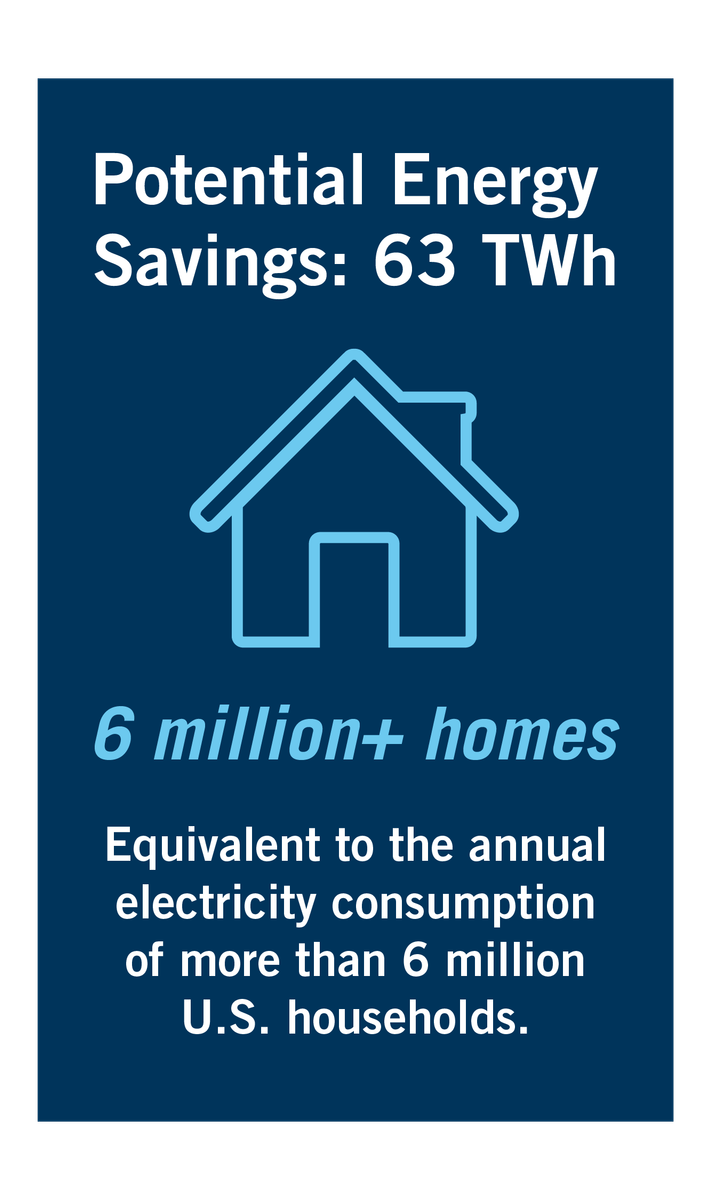
This update has the potential to create 63 TWh of global energy savings annually – equivalent to the annual electricity consumption of more than 6 million U.S. homes or entire small-to-medium-size countries such as Switzerland, Greece or Austria.
These changes are expected to drive ongoing voluntary efficiency improvements that will benefit Northwest consumers and utilities through lower energy use, reduced electricity bills and sustained Market Transformation – all while increasing consumer choice and access to efficient TV options for this nearly ubiquitous product.
The Long View of Market Transformation
None of these milestones happened independently. They are the result of years of research, relationship building and collaboration across manufacturers, efficiency organizations, regulators and standards bodies.
A more representative TV test procedure helped create the foundation for voluntary efficiency commitments. That technical work, known as ‘the NEEA standard,’ is now informing international standards.
Better TV energy data is strengthening collaboration across organizations, which in turn is creating opportunities to influence efficiency for an even broader range of consumer products.
As these pieces come together, they illustrate the long-term nature of Market Transformation: deliberate investment can build momentum that eventually reaches far beyond a single project, product or region.
For NEEA and the Northwest, that momentum means more efficient products in every home, better market visibility and lasting energy savings for consumers and businesses.